What happens to free cash flow after stock comp at three software giants?
Amber Research ·
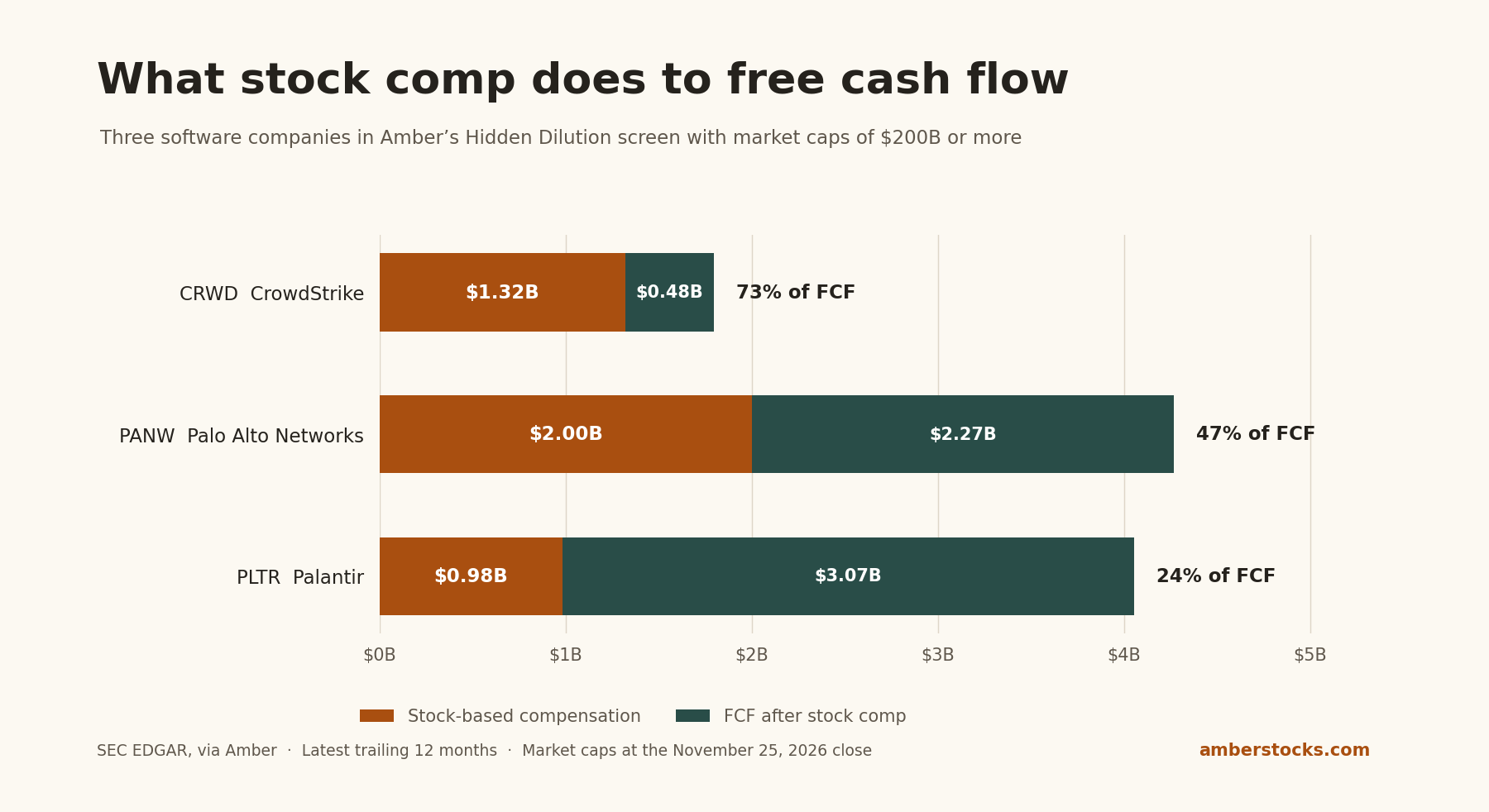
CrowdStrike generated $1.80 billion of trailing free cash flow and recorded $1.32 billion in stock-based compensation over the same period. After subtracting stock comp, $477 million remains, or 8.3% of revenue. Palo Alto Networks and Palantir pass the same screen, with different results.
| Company | FCF before SBC | SBC | FCF after SBC | SBC / FCF | After-SBC margin |
|---|---|---|---|---|---|
| CrowdStrike$1.80B FCF before SBC $1.32B SBC | $1.80B | $1.32B | $0.48B | 73% | 8.3% |
| Palo Alto Networks$4.27B FCF before SBC $2.00B SBC | $4.27B | $2.00B | $2.27B | 47% | 18.2% |
| Palantir$4.05B FCF before SBC $0.98B SBC | $4.05B | $0.98B | $3.07B | 24% | 42.2% |
Palo Alto had the largest stock-comp expense in dollars. CrowdStrike had the largest expense relative to its cash flow. Palantir retained the highest after-SBC margin of the three while its diluted share count grew about 7.5% annually in Amber’s four-year comparison, versus 6.6% at Palo Alto and 2.5% at CrowdStrike. The after-SBC margin and the change in diluted shares answer different questions about the economics for each share.
Compare the three companies in Amber
How we measured it
The November 27 snapshot covers all three matches in Amber’s Hidden Dilution screen worth at least $200 billion at the November 25 close. The screen uses SBC as a share of revenue. The table ranks the matches by SBC as a share of free cash flow. Figures cover the latest trailing twelve months available for each company.
Amber calculates free cash flow as operating cash flow minus capital expenditures, then subtracts reported stock-based compensation to get True FCF. Stock comp is a noncash expense. Subtracting it shows how much of the cash flow is offset by the reported cost of equity compensation.